When you arrive in Žilina, it is usually by train. The first railway reached Žilina in 1870 from the north (Ostrava, Bohumín & Český Těšín in Czech Republic). The original railway station looked much like plenty other 19th century station buildings in Austro-Hungarian monarchy.

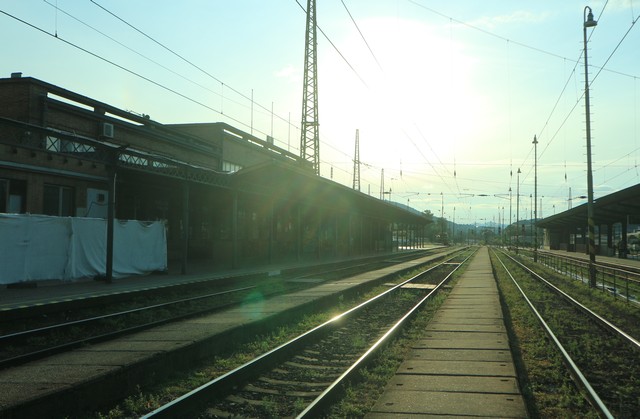
It does not exist anymore as it was replaced in 1939 by a strictly functionalist (read: hideous) building designed by František Eduard Bednárik and his brother-in-law Ferdinand Čapka with the saving grace of stained glass windows.

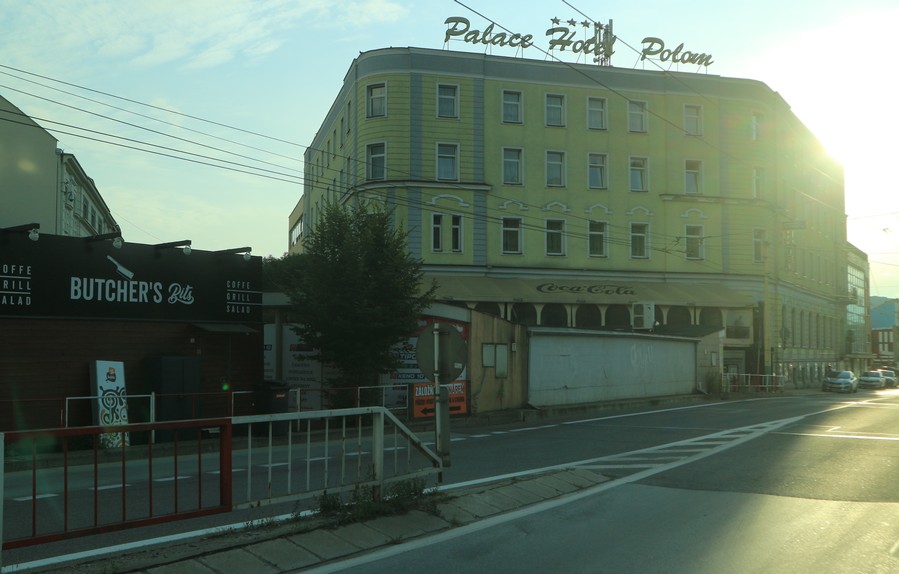
Moving on. After you stepped out of the train and emerged from the station building, the first building to catch your attention would have been Palace Hotel Rémi, now known as Palace Hotel Polom.
The history of this hotel, as many other buildings in then-booming Žilina, dates to the turn of the century and early 1900s (or noughties of the 20th century, as the British would have it). It was THE time to go big and build Art Nouveau in Žilina at the confluence of three rivers – and four railways, coming from all cardinal directions. Essentially, whether you were travelling from Istanbul to Copenhagen, or from Moscow to Paris, you had to pass stop in Žilina on your way. And hotel Rémi was the place to be to get updated on all the gossip and where all the barter trades had been struck during a game of pool, chess, or cards.
In 1895, Hendrich Ziegeltuch of Auschwitz (his name literally means brick cloth) built a simple two-storey inn next to the railway station. There was neither electricity, nor plumbing – not even a paved road!
Ziegeltuch promptly changed his name to Henrich Rémi and I can only guess rampant anti-semitism of the times may have had a hand in it. He then proceeded to by a plot opposite his establishment from Karol Grün, a building entrepreneur.
The hotel, named after its first owner, was originally envisaged as a two-storey structure. Built by Karol Grün’s company on a plot of land he had previously sold to Mr Rémi, the Art Nouveau Hotel Rémi was the most representative (biggest, most modern, most luxurious…) of 6 pre-war hotels for 10-thousand strong Žilina with its 30 rooms, central heating, and electric lighting.


After Henrich’s death in 1928 the hotel passed to his children Alfréd and Šarlota. That same year, they built the third floor with an attic of the fourth, as designed by architect Jozef Konrád, like so:

Source: Juraj Nedorost’s collection of Žilina postcards
This upgrade, together with a new annex from 1924 enlarged the capacity to 85 rooms.
In 1945 the hotel briefly changed name to Moskva (Moscow), only to revert back to Rémi. Having been nationalized in 1950, it changed name again to Polom, after one of three mountains encircling Žlina. Currently it’s a four-star hotel belonging to the Best Western chain.


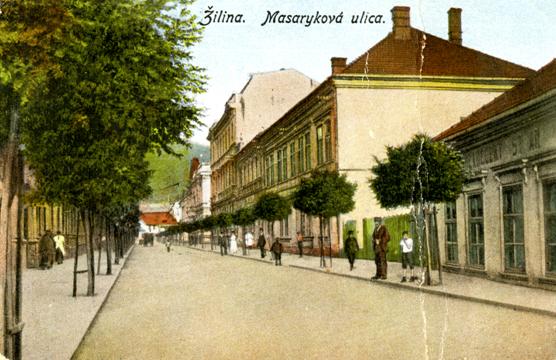
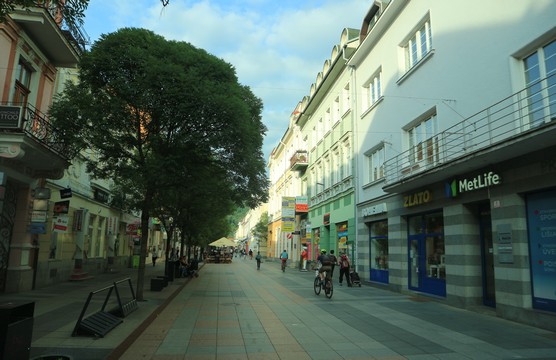
After crossing the street and passing Hotel Polom, a major pedestrianized boulevard opens. It was developed at the turn of the century to connect the newly built railway station with the historical city centre. Originally called Železničná ulica (Railway street), it gained a new name in 1901 – Kossuth Lajos utca (Lajos Kossuth Street, after the eponymous Hungarian statesman). Subsequently, it was renamed to T. G. Masaryka (Tomáš Garrigue Masaryk Street) post World War I (1919), then Hlinkova ulica (Andrej Hlinka Street) during Slovak WWII satellite state (1939), before briefly returning to Masarykova after the war (1945). Three years later, following the Victorious February illegal communist coup (1948), the street name was again changed to Ulica SNP (Slovak National Uprising Street). After the fall of communism, the city returned (yet again!) to Masarykova street (1990), only for it to be changed on the verge of independence (1992) to Národná ulica (National Street).
Continuing along Národná towards the old town, we will stop after a hundred or so paces and look back at the station:

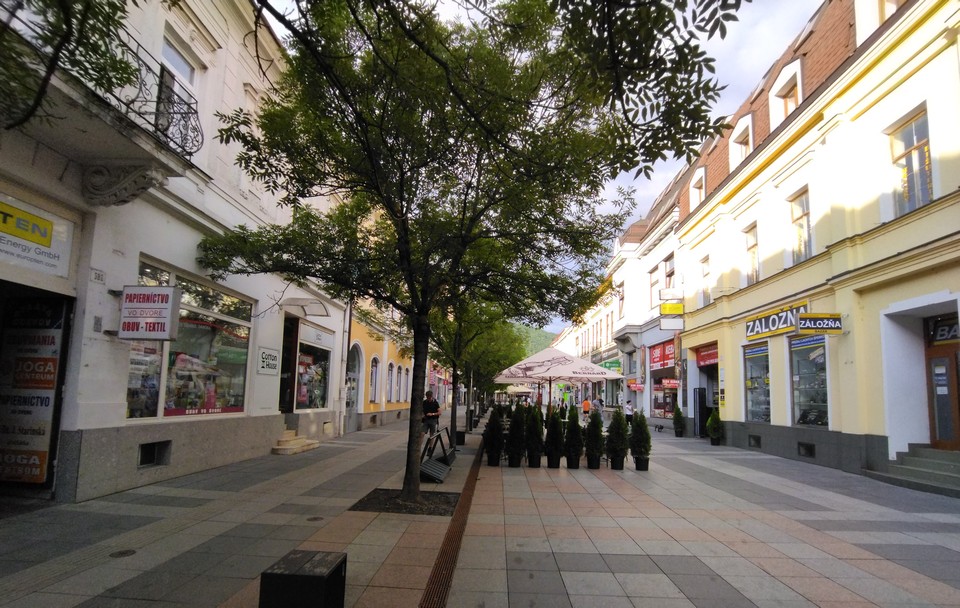
It was impossible to take the picture from the original vantage point due to the profusion of trees growing there presently. But let’s continue further on.
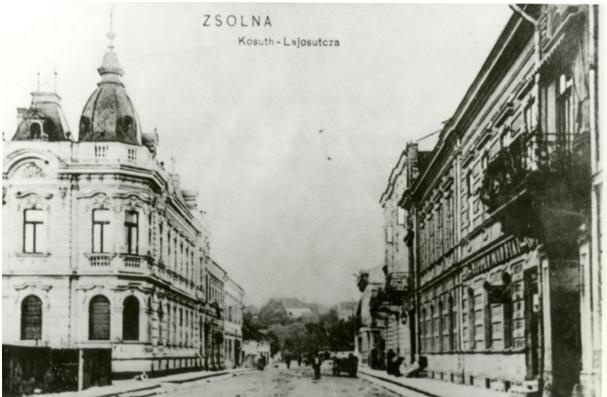
After heading south towards the historical downtown again, we will quickly come across the former building of the Ministry of Agriculture. This pretty, mostly Art Nouveau, building was erected in 1904 by Július Grün, also a building entrepreneur, just like his namesake Karol. Originally there were only two floors, topped with a shapely corner tower:

Source: State Archive in Žilina
Barely 8 years later, however, the building received another floor. Between December 1918 and February 1919, it shortly served as the seat of Ministry for the administration of Slovakia in the newly formed Czechoslovakia, which was a de facto Slovak government.
The pretty pink house on the left with two balconies is Samuel Frankl’s house.
Source: State Archive in Žilina
In 1929, the ground floor including its windows and entrance was refurbished and for the next years it hosted Július Hoffmann‘s furniture shop with a warehouse and carpenters’ workshop. In 1932, the building was acquired for 1 milion Czechoslovak crowns by Jozef Buxman‘s family, but the building continued to serve as a furniture shop, even after its 1949 nationalization. Nowadays, it is used by UniCredit Bank.
Already we have reached about halfway up Národná Street. If you turn back, facing towards the railway station, you will see, on your right right across from UniCredit Bank, an inconspicuously beautiful 1906 eclectic building (again, mainly Art Nouveau) of the former Hungarian Royal District Court.


Source: State Archive in Žilina
It was built by Július Grün (again!) and the building hosted a court even in the contemporary First Czechoslovak Republic, including a prison in an annex off a side street, which is now a hotel. The building changed hands several times until it was appropriated during second world war.
In 1970 a barbaric reconstruction did away with ground floor’s Art Nouveau façade facing Národná Street in favor of large format aluminum shop windows and since then the building has been hosting most mundane of shops.
But let’s continue to the old town. After having crossed Národná, we will enter the massive Hlinkovo námestie (Andrej Hlinka Square), through which a small brook called Všivák used to flow until it was buried in 1941. On the right side, we can see Park SNP:


You cannot see anything in this picture, because Všivák is underground and the park trees have grown quite a bit (also notice how the mountain changed from barren and treeless to lush and forested). The beautiful big white building on the right is currently yellow and hosts Senegal’s Honorary Consulate, among other tenants.
This park (or orchard) is the oldest one in Žilina, as it dates to late 19th century. Some of the lovely Art Nouveau villas you can see on the far side look nowadays exactly the same. But that’s for another blogpost.


Its original name was Elisabeth’s Park in Sissi’s honor. In early 20th century the park received a wooden musical pavilion. 1913 and the park changed its name to Millennium Park to celebrate 1000 years of the arrival of Hungarians (in 896). It was a typical park with a river course and wide chestnut alleys, occasionally interspersed with lime trees or maples here and there.
In the then Czechoslovakia, the park got renamed again, this time after the de facto Slovak premier Vavro Šrobár. Indeed, it was a weird custom at the time to name toponymical features (parks, streets, even whole settlements!) after living – and still serving – politicians. During the Slovak wartime independent state it was named after Andrej Hlinka and after the war after the military figure of partisan leader Anton Sedláček, who had been hanged in front of Remeselnícky Dom on November 15, 1944.
Which brings me to… Remeselnícky Dom, essentially translated as House of Artisans. Another piece of Art Nouveau architecture, this two-storey house with its decorative turrets was built between 1909 and 1910 by local industrial association (chamber of industry) on a land plot adjacent to the park and donated by the city.
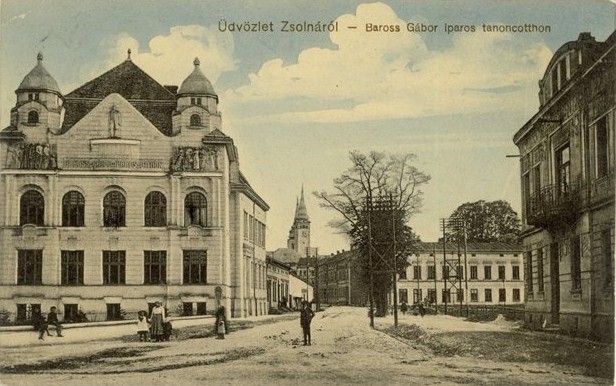
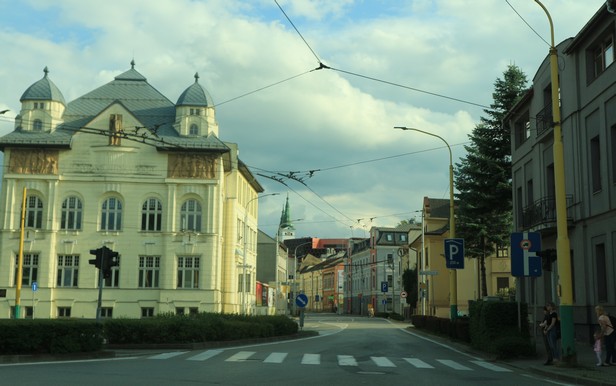
The building was then renamed in honor of Gabriel Baross who was born not far from Žilina in Upper Hungary, and reached high-ranking governmental positions as a Minister of Public Works and Transport and a Minster of Trade (beside shortly serving as an acting Minister of Religion and Education and also of the Interior).
A busy young man, if you ask me.
In any event, he was instrumental to the development of railways in the region and a supporter of industry, trade, and education, thus an undoubted patron of Žilina prosperity. He also established Hungarian Industrial and Commercial Bank and a cloth factory in Žilina that survived in one form or another until present.
If you look carefully at the House façade, you will discover Dezider Lányi’s reliefs that depict craftsmen on both sides with Gabriol Baross a towering figure above them in the middle. Luckily, he was long dead by then, so no cult of living politician.
What you see in the background of this picture are the towers of the Holy Trinity Cathedral church. We’ll get there in part II.
 Back home | © 2003-2021 3Dependent Traveller